


Rishi Sunak enters Downing Street with a programme for government mostly written after winning the Conservative leadership at the second attempt.
Mr Sunak set out his vision during his failed leadership bid in the summer, with his economic programme now seen as vindicated after he warned against the tax cuts that brought down Liz Truss.
After Ms Truss resigned, he said he was running again to fix Britain's economy and unite the warring Conservative Party.
"I have the track record of delivery, a clear plan to fix the biggest problems we face and I will deliver on the promise of the 2019 manifesto," he said.
"There will be integrity, professionalism and accountability at every level of the government I lead and I will work day in and day out to get the job done."
Regarded by supporters as a safe pair of hands in turbulent times, Mr Sunak will dust off promises on the economy, energy, defence and crime that Tory members rejected only weeks ago.
Economy
Mr Sunak, the former chancellor of the exchequer, put economic prudence at the heart of his summer campaign.
He said he would only lower taxes once Britain had “gripped inflation” — while Ms Truss’s immediate package of tax cuts would not be credible and would push up mortgage costs, he said.
“He was right about the economy during the summer; we need his leadership to get us back on track,” said one Tory MP, Guy Opperman.
Under pressure at the time to offer a more radical vision, he said he would eventually cut the basic rate of income tax from 20 per cent to 16 per cent, but possibly not until 2029.
In other areas, Mr Sunak had a similar vision to Ms Truss. He promised to trim the civil service, push ahead with low-tax freeports — Ms Truss called them investment zones — and make the most of post-Brexit freedoms.
He said he would pressure developers to construct homes more quickly, to “build the next generation of Conservative voters”.
Rishi Sunak through the years - in pictures
-
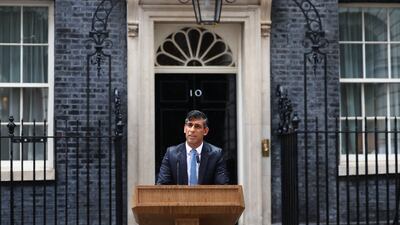
British Prime Minister Rishi Sunak announces July 4 as the date for the 2024 general election at No 10 Downing Street. Here, The National looks back at his political career. Getty Images -
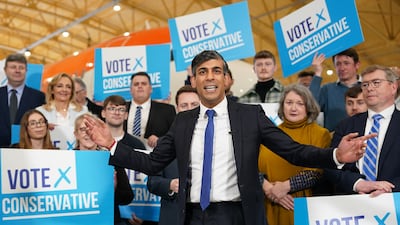
Mr Sunak during local election campaigning in Teesside in May 2024. Getty Images -
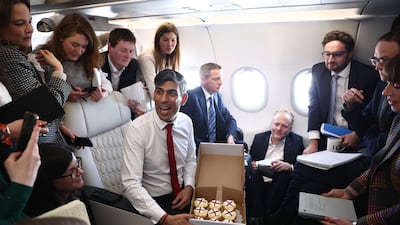
Mr Sunak presents cupcakes to journalists on board a plane on the way to Warsaw in April 2024. Getty Images -
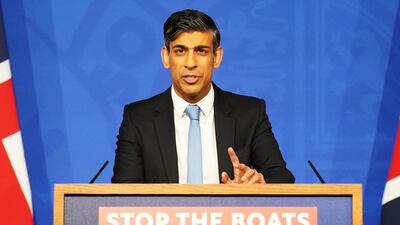
Mr Sunak during a press conference in Downing Street in January after the Safety of Rwanda Bill passed its third reading in the House of Commons. Getty Images -
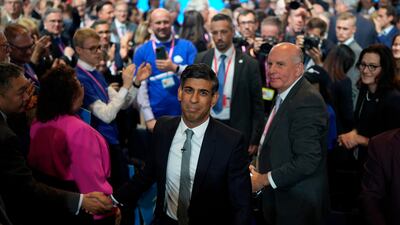
Being applauded after his speech at the Conservative Party conference in October 2023. Getty Images -
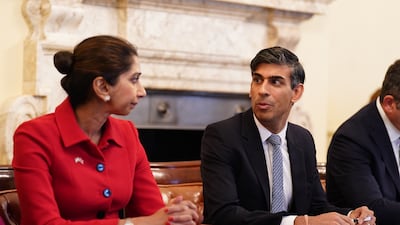
Looking pensive alongside then-home secretary Suella Braverman at No 10 in October 2023. She didn't last much longer in the cabinet. Getty Images -
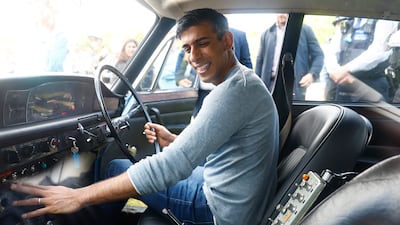
Mr Sunak sits in an old Special Branch police vehicle which was used to transport former prime minister Margaret Thatcher, in July 2023. Getty Images -

On board Border Agency cutter HMC Seeker during a visit to Dover in June 2023. Getty Images -
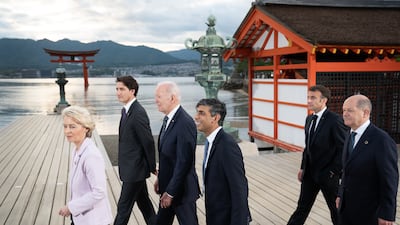
Mr Sunak alongside European Commission President Ursula von der Leyen, Canada's Prime Minister Justin Trudeau, US President Joe Biden, French President Emmanuel Macron and German Chancellor Olaf Scholz during the G7 Summit in May 2023. Getty Images -
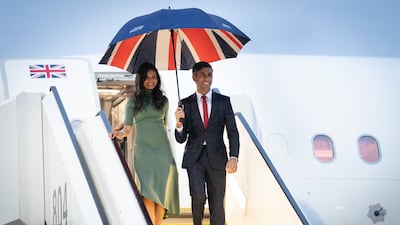
Mr Sunak and his wife Akshata Murty arriving in Japan ahead of the G7 Summit in May 2023. Getty Images -
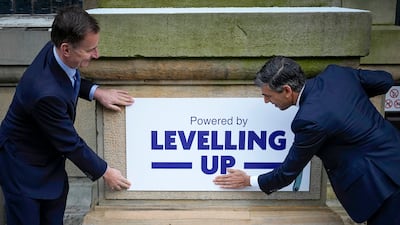
Mr Sunak and Chancellor Jeremy Hunt sending a message at Accrington Market Hall in January 2023. Getty Images -
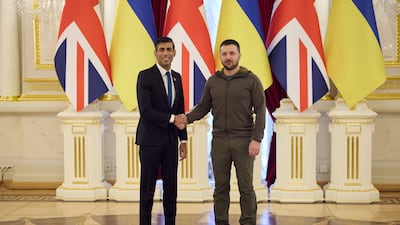
Mr Sunak and Ukrainian President Volodymyr Zelenskyy meet in Ukraine's capital Kyiv in November 2022. Getty Images -

King Charles III welcomes Mr Sunak during an audience at Buckingham Palace, where he invited the newly elected leader of the Conservative Party to become Prime Minister and form a new government in October 2022. Getty Images -
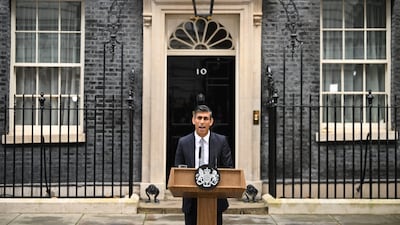
Mr Sunak makes a statement outside No 10 in October 2022 after taking office. Getty Images -
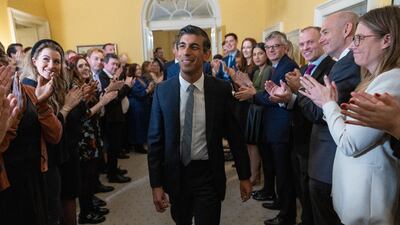
Mr Sunak arrives inside Number 10 in October 2022. Photo: Simon Walker/ No 10 Downing Street -
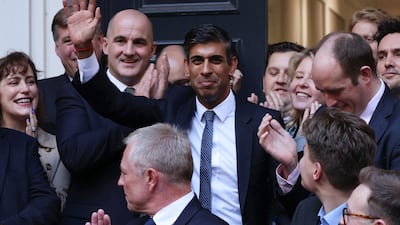
Greeted by colleagues at Conservative Party HQ after having been announced winner of the leadership contest in October 2022. Getty Images -
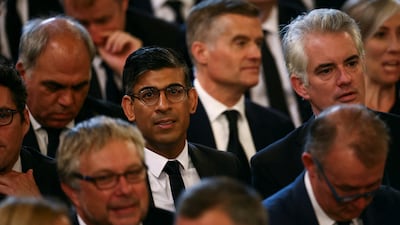
Mr Sunak at Westminster Hall in London following the death of Queen Elizabeth II in September 2022. PA -

Mr Sunak visits his family's old business, Bassett Pharmacy, on the campaign trail in August 2022. Getty Images -
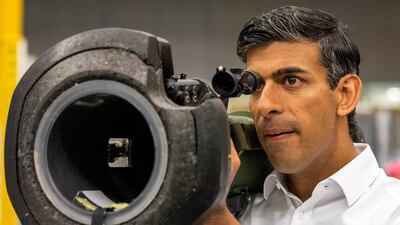
Mr Sunak looks at an NLAW anti-tank launcher during a visit to the Thales Defence System plant in Belfast in August 2022. Getty Images -
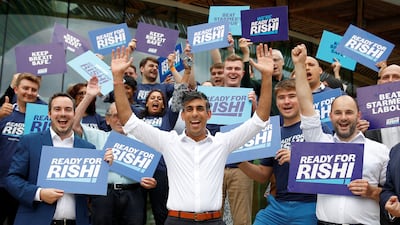
At a hustings event in Exeter in August 2022. Getty Images -
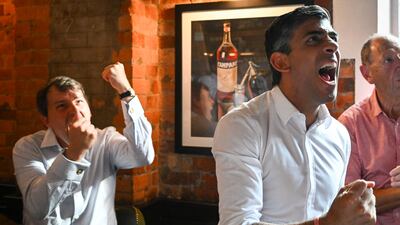
Celebrates England's first goal as he watches the Women's Euro 2022 final in Salisbury in July 2022. Getty Images -
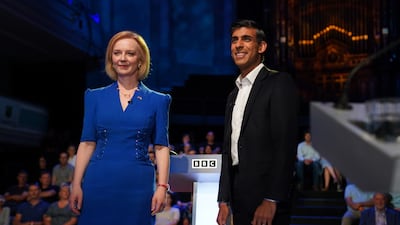
Mr Sunak and Ms Truss take part in the BBC Leadership debate at Victoria Hall, Hanley, in July 2022. Getty Images -
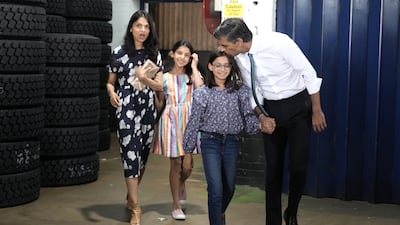
With daughters Krisna and Anoushka and wife Akshata Murthy in July 2022. Getty Images -
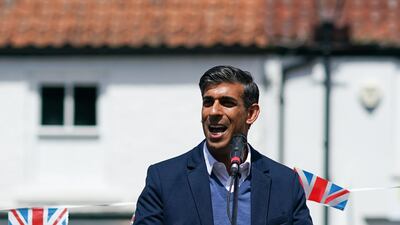
Opening the Great Ayton Village Fete during the queen’s Platinum Jubilee celebrations in June 2022. Getty Images -
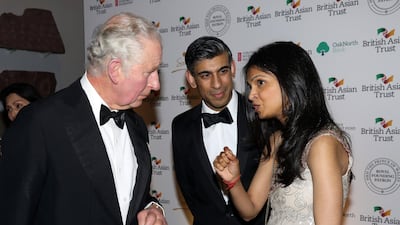
Mr Sunak and Ms Murthy speak to then-Prince Charles at a British Asian Trust event in February 2022. Getty Images -
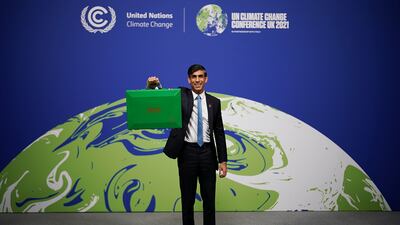
Mr Sunak arrives at COP26 in Glasgow in November 2021 when he was chancellor. Getty Images -
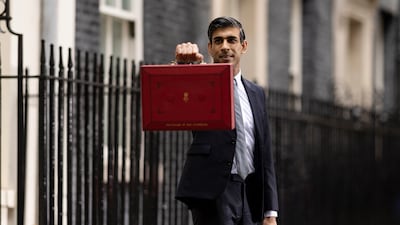
Holding the budget box as he departs 11 Downing Street to deliver his Autumn Budget in October 2021. Getty Images -
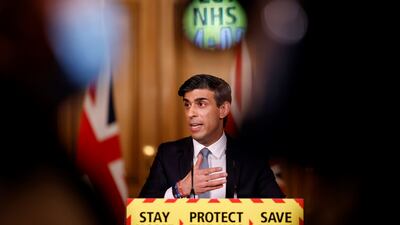
At a press conference on the 2021 Budget in London in March 2021. Getty Images -
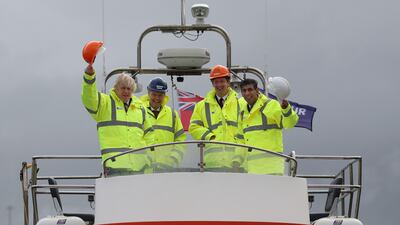
With former prime minister Boris Johnson during a visit to PD Ports on the River Tees in March 2021. Getty Images -
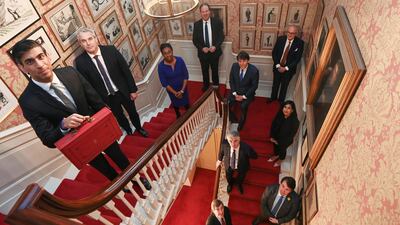
Mr Sunak poses with the budget box at 11 Downing Street in March 2021. Getty Images -
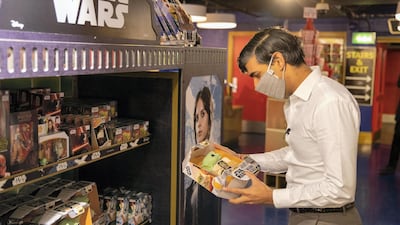
Meeting staff back at work after being furloughed at Hamleys toy shop in London, December 2020. Photo: HM Treasury -
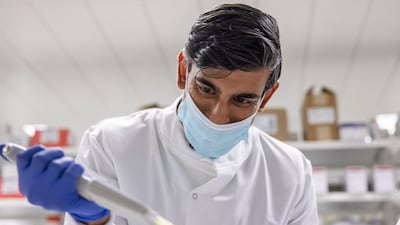
Mr Sunak visits the Imperial Clinic Research Facility at Hammersmith Hospital, London, in November 2020. Getty Images -
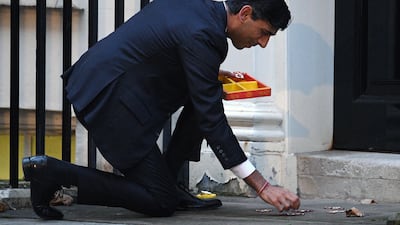
Lighting a candle for Diwali on Downing Street, November 2020. Getty Images -
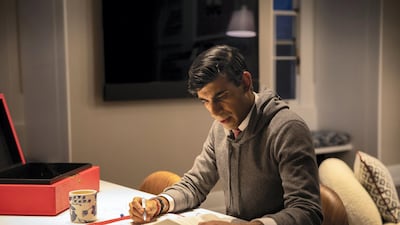
Working on a speech in his flat above 11 Downing Street in November 2020. Photo: HM Treasury -
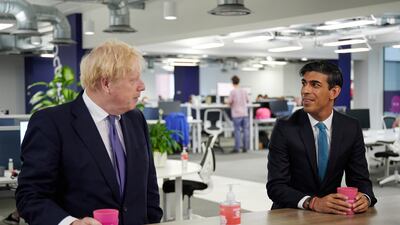
Mr Johnson and Mr Sunak visit the headquarters of Octopus Energy in London in October 2020. Getty Images -
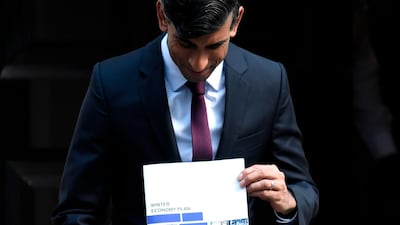
With his 'Winter Economy Plan' outside 11 Downing Street in September 2020. AFP -
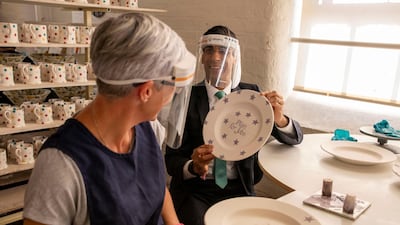
Decorating a plate at Emma Bridgewater pottery in Stoke pottery in September 2020. Getty Images -
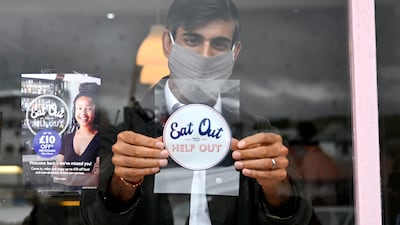
Promoting 'eat out to help out' on the Isle of Bute, Scotland, in August 2020. Getty Images -
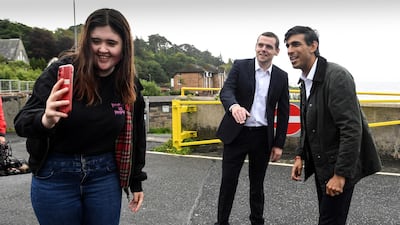
A member of the public takes a selfie with Rishi Sunak during a visit to Scotland in August 2020. AFP -

Visiting a Wagamama restaurant in central London in July 2020. Photo: HM Treasury -
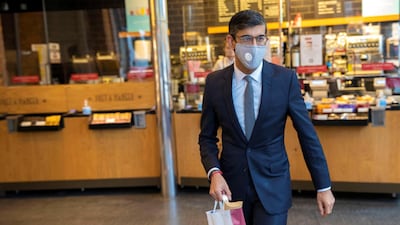
Rishi Sunak visits a Pret A Manger in Westminster in July 2020. HM Treasury -
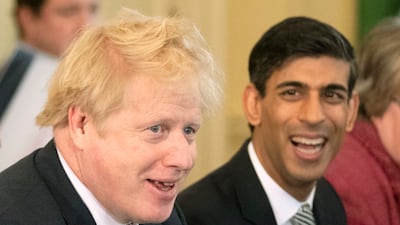
With Mr Johnson at his first Cabinet meeting after a reshuffle at 10 Downing Street in February 2020. Getty Images -
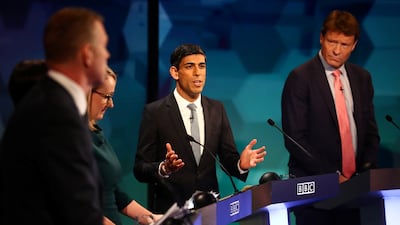
Mr Sunak speaks during a general election debate in Cardiff in November 2019. Getty Images


Energy
Mr Sunak promised to support people through a winter of high energy bills, having criticised Ms Truss for wavering over handouts.
Once in office, Ms Truss changed tack and brought in a price cap, although Jeremy Hunt, the current chancellor, said it would only last until April in his emergency measures to stabilise markets. All eyes will be on Mr Sunak to see if he makes changes to the scheme.
Like Ms Truss, he supported the resumption of shale gas fracking, and called for more nuclear power, offshore wind and North Sea oil and gas exploration.
He said he was committed to net zero emissions by 2050 but would introduce a new target of making Britain energy independent by 2045.
In a play to the homeowning Tory base, he said he would not allow wind farms to be built more easily on the mainland.
Ms Truss’s government, by contrast, announced in its doomed growth plan that planning rules would be relaxed for onshore wind.
Defence and foreign affairs
Mr Sunak is something of an unknown quantity in foreign affairs, having served only in domestic roles in government, but would walk into office amid growing alarm over Russian President Vladimir Putin’s nuclear threats.
In his first campaign, he promised Ukraine that Britain would “remain your strongest ally” in the war with Russia and that his first foreign visit would be to Kyiv.
When asked whether French President Emmanuel Macron was a friend or foe, he had no hesitation in answering friend — avoiding the diplomatic storm that Ms Truss caused by saying the jury was still out.
Unlike Ms Truss, who said defence spending would rise to 3 per cent of GDP, Mr Sunak said he would not set an “arbitrary target”.
But he promised a package of measures to counter Chinese influence in the UK, including by giving MI5 more oversight of businesses and universities.
Another question would be whether to reappoint Defence Secretary Ben Wallace, who is respected in the party but backed Ms Truss over the summer.
Home affairs and immigration
Mr Sunak promised to take the French to task over their efforts to stop migrants crossing the English Channel.
He said he would do “whatever it takes” to start deportations to Rwanda, a scheme bogged down in legal wrangling.
A 10-point Sunak plan on immigration also included tightening the definition of asylum and setting a cap on the annual number of refugees.
Ms Truss had been mulling a more liberal immigration policy to plug economic gaps, putting her at odds with former home secretary Suella Braverman.
In a crackdown on crime, Mr Sunak said in his campaign that he would double the number of foreign offenders being deported.
He said he would go after career criminals by adding a year in prison to any sentence they might receive.

